
Lean, Six Sigma (via DMAIC), Kaizen, PDCA, 5 Whys, TQM, and BPM cover most of what managers need. Start with Lean when waste and slow flow are visible; move to Six Sigma/DMAIC when defects or variation need statistical proof; blend the two into Lean Six Sigma when speed and precision both matter. The rest of this guide explains when each earns its place and how to run it without losing momentum after week three.
TL;DR:
- Most frameworks deliver results within a few weeks to six months, with Lean showing quick wins and DMAIC requiring longer, structured projects.
- Lean is ideal for visible waste and flow issues and can be launched with minimal training, while Six Sigma requires statistical skills and longer timelines.
- Proper sequencing involves starting with Lean to eliminate obvious waste before applying Six Sigma's statistical tools for remaining variation.
- Effective implementation depends on reliable baseline data, stakeholder alignment, leadership support, and ongoing monitoring to sustain improvements.
- Future Grid integrates automation into process improvement, ensuring gains are maintained through continuous monitoring and reducing manual oversight.
Table of Contents
- Process improvement frameworks at a glance
- Lean vs Six Sigma: which one actually fits your problem?
- How do you choose the right process improvement framework?
- Running the framework: steps, tools, and realistic timelines
- How Future Grid applies these frameworks in practice
- Why frameworks fail without a change in philosophy
- Turning frameworks into results with Future Grid
- Sources
Process improvement frameworks at a glance
Every framework here solves a slightly different problem, and picking the wrong one wastes months. Here's what each actually does, who it suits, and how long before you see something worth reporting to the board.
- Lean strips out non-value-adding steps and speeds up flow. It suits teams drowning in handoffs, approvals, or duplicate data entry. A focused Lean effort (a value stream mapping exercise plus a few quick fixes) can show results within a few weeks. Tools: value stream mapping (VSM), 5S, kanban boards. Training barrier is low; most teams run their first Lean exercise with a half-day workshop.
- Six Sigma (DMAIC) targets variation and defects using statistics rather than intuition. It's the right call when a process is inconsistent in ways nobody can explain, and where the cost of getting it wrong is measurable in scrap, rework, or compliance failures. DMAIC, the five-phase structure behind Six Sigma, typically runs three to six months per project. Training is the real barrier here: Green Belt or Black Belt certification takes weeks of study, and without that grounding, teams misuse the statistical tools.
- Lean Six Sigma merges the two: use Lean thinking to simplify the process, then apply Six Sigma's statistical rigour where variation persists after the simplification. This hybrid suits mature operations teams tackling complex, cross-functional processes. Expect a longer runway, often four to eight months, because you're running two methodologies in sequence rather than one.
- Kaizen is continuous, incremental improvement, usually delivered through short, intense "kaizen events" involving frontline staff. It needs almost no formal training and is the most accessible entry point into structured improvement work. A kaizen event typically runs a few days and produces immediate, visible changes to a specific workflow. The catch is that gains tend to be local; kaizen doesn't naturally scale into enterprise-wide transformation without a supporting framework around it.
- PDCA (Plan-Do-Check-Act) is the simplest improvement loop of the lot: propose a change, test it, measure what happened, then standardise or adjust. It works well for smaller, contained problems where you can run a fast experiment. The catch, according to ASQ's own guidance, is that the Check and Act phases get skipped under time pressure, which means teams repeat the Plan-Do loop endlessly without ever locking in a gain.
- 5 Whys is a root-cause technique, not a standalone framework. Ask "why" five times (or until you hit the actual cause) and you move past symptoms. It pairs naturally with Lean, Kaizen, or the Analyse phase of DMAIC, and it costs nothing but fifteen minutes and a willingness to be uncomfortable with the answers.
- TQM (Total Quality Management) is an organisation-wide philosophy rather than a project method. It asks every function, not just operations, to treat quality as everyone's job. TQM suits organisations trying to shift culture over one to three years, not teams looking for a quick fix. It's slower to show returns but changes how decisions get made long after the initial rollout.
- BPM (Business Process Management) is the umbrella discipline of modelling, automating, monitoring, and continuously redesigning end-to-end processes, often with software support. BPM suits organisations managing many interconnected processes rather than a single pain point, and it typically involves ongoing platform investment rather than a fixed project timeline.
This list mirrors what most practitioner guides converge on as the standard toolkit, though the sequencing and depth you apply should depend entirely on the problem in front of you, not on which framework has the best branding.
Lean vs Six Sigma: which one actually fits your problem?
Lean and Six Sigma get lumped together so often that managers assume they're interchangeable. They're not. Lean is about speed and flow. Six Sigma is about precision and consistency. Confusing the two is the single most common reason process improvement projects stall.
Lean asks: where is the waste, and how do we remove it? It uses visual tools, team workshops, and rapid iteration. Lean thinking works well for visible waste and flow problems because you can usually see the bottleneck without needing a data scientist to find it.
Six Sigma asks: why does this process behave inconsistently, and what's causing the spread? It leans on statistical control, hypothesis testing, and structured data collection. The famous Six Sigma quality target is an extremely low defect rate per million opportunities, a benchmark that only makes sense once you have enough data to measure variation precisely, which is exactly why Six Sigma demands more specialist skill than Lean.
Here's a rough decision matrix for the choice managers face most often:
- Long lead times, excess inventory, or too many handoffs: start with Lean.
- Inconsistent output quality with no obvious cause: start with Six Sigma/DMAIC.
- A bottleneck everyone can point to on a whiteboard: Lean, almost always.
- A defect rate that fluctuates for reasons nobody agrees on: Six Sigma, because you need data to settle the argument.
- A complex, cross-functional process with both flow problems and quality variation: Lean Six Sigma, sequenced Lean first, then Six Sigma on what's left.
The sequencing matters more than most guides admit. Run Lean first to strip out the obvious waste, because it's cheaper and faster, and because a simplified process is easier to measure accurately afterwards. Only then bring in Six Sigma's statistical tools for whatever variation survives the simplification. Doing it the other way round means you spend weeks running control charts on a process that's about to be redesigned anyway.
There's a resourcing and culture cost to be honest about too. Lean thrives on frontline participation and can be led by operations managers with basic training. Six Sigma needs someone with genuine statistical competence, usually a certified Green Belt or Black Belt, and that person's time isn't free. If your organisation doesn't have that skillset in-house yet, factor training time into your project plan before you commit to a Six Sigma timeline.
How do you choose the right process improvement framework?
Pick a framework the way you'd pick a tool for a repair job: by matching it to the actual fault, not by grabbing whatever's nearest. Work through these questions before you commit a team to months of effort.
- What kind of problem is it? Waste and flow issues point to Lean. Variation and defect issues point to Six Sigma. Ambiguous or cultural issues point to Kaizen or TQM.
- How much data do you already have? Six Sigma without reliable data is guesswork dressed up in Greek letters. If you can't produce baseline numbers for the last three to six months, spend time on measurement system analysis first, because a shaky baseline wastes the entire project downstream.
- What's the scale of the impact? A single team's workflow suits a Kaizen event. An enterprise-wide bottleneck spanning several departments suits DMAIC or BPM.
- What skills does your team already have? Nobody trained in statistical process control? Don't start with Six Sigma. Build Lean or Kaizen capability first, then layer in Six Sigma once you have internal champions.
- What's your realistic timeline and budget? A kaizen event fits inside a sprint. A full DMAIC project needs months and a dedicated project lead. Be honest about which one your calendar actually allows.
- What baseline metrics do you need before you touch anything? Cycle time, defect rate, first-pass yield, cost per transaction, whatever's relevant to the process, and capture it before you change a single step.
Ask your stakeholders directly: what does success look like in numbers, not adjectives? "Faster" and "better" aren't baselines. "Cycle time from 14 days to 9 days" is.
Watch for red flags that should change your approach. If leadership wants results in two weeks but the problem is genuinely variation-driven, don't force a Six Sigma timeline into that window, run a Kaizen event on the most painful symptom instead and schedule the real DMAIC project properly. If nobody can agree on what the current process even looks like, that's a sign you need basic process mapping before any framework, full stop.
Governance doesn't need to be heavy, but it does need to exist. At minimum, assign a process owner accountable for the outcome, a project sponsor senior enough to remove blockers, and someone responsible for measurement who isn't also grading their own homework.
Pro Tip: Capture your baseline metrics before you announce the project to the wider team. Once people know changes are coming, behaviour shifts, and your "before" numbers stop being an honest before.
Running the framework: steps, tools, and realistic timelines
Theory doesn't fix a bottleneck. Execution does, and execution follows a fairly consistent pattern regardless of which framework you've chosen.
Start with a baseline map. A SIPOC diagram (Suppliers, Inputs, Process, Outputs, Customers) gives you a high-level view of the process boundaries in under an hour. A value stream map goes deeper, showing every step, wait time, and handoff in a Lean context. Both exist to answer the same question: what actually happens today, not what the process document says should happen.
From there, run your core cycle:
- Define the problem and scope with a clear, measurable statement, not "improve customer service" but "reduce average ticket resolution time from 48 hours to 24 hours."
- Measure the current state using validated data collection, not anecdotes from the loudest person in the room.
- Analyse root causes using 5 Whys or an Ishikawa (fishbone) diagram to separate genuine causes from symptoms.
- Improve by testing changes on a small scale first, a single team, a single shift, a single product line, before rolling out wider.
- Control by locking the gain in with updated standard operating procedures, visual management boards, and a monitoring cadence that someone actually owns.
Match your tools to the phase. Root cause work leans on 5 Whys and Ishikawa diagrams. Risk assessment before a rollout benefits from an FMEA (Failure Mode and Effects Analysis), which forces you to rank what could go wrong by severity and likelihood before it actually goes wrong. Ongoing monitoring after the project closes relies on control charts, simple statistical tools that flag when a process drifts outside acceptable limits.
That Control phase is where most projects quietly fail. ASQ's own guidance on DMAIC is blunt about it: skip the control plan, and the process drifts back to its old habits within months, sometimes weeks. An SOP update that nobody reads isn't a control plan. A control chart nobody checks isn't monitoring. Assign explicit ownership for watching the metric after the celebratory closeout meeting, or the entire project was theatre.
Piloting matters as much as the fix itself. Roll a change out to one team, watch it for two to four weeks, and only then scale it. This catches the failure modes your FMEA missed and gives you a second, smaller dataset to validate against before you commit the whole organisation.
For realistic timelines: a kaizen event delivering a quick win runs several days. A PDCA cycle on a contained problem might run several weeks per loop. A full DMAIC project, done properly with proper baseline measurement and a control plan at the end, typically runs three to six months. Anyone promising enterprise-wide Six Sigma results in three weeks is either lying or hasn't reached the Control phase yet.
How Future Grid applies these frameworks in practice
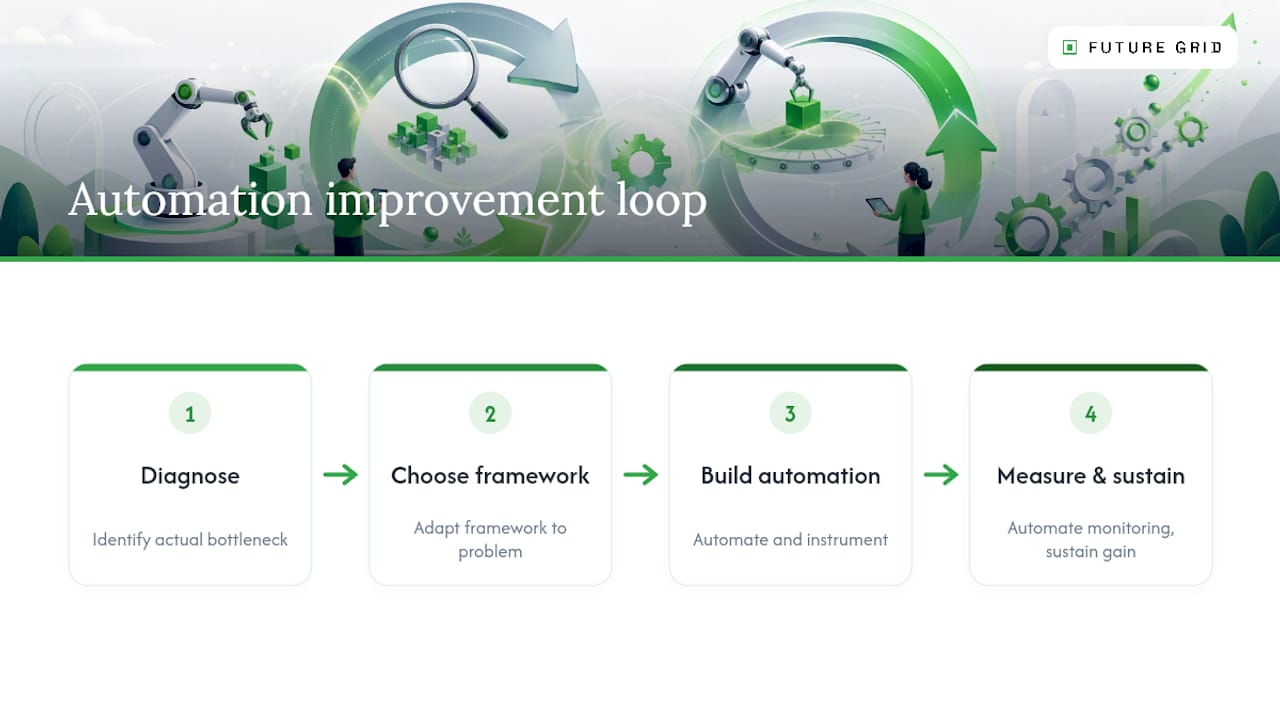
Future Grid's working model follows the same logic outlined above, but with automation built into every phase rather than bolted on afterwards. The approach runs in four stages: diagnose the actual bottleneck (not the assumed one), select or adapt the right framework for that specific problem, build the automation and instrumentation needed to run it, then measure and sustain the gain.
That instrumentation step is where a lot of manual process improvement work falls short. Teams run a solid DMAIC or Lean project, get the win, then watch the metric quietly drift because nobody's watching it three months later. Future Grid's operations automation work is built specifically to close that gap, turning control plans into monitored systems rather than documents that sit in a shared drive.
The gap between running a process improvement project and sustaining its result is almost always a measurement gap. Baseline it properly, automate the monitoring, and the improvement holds. Skip that step, and you're re-running the same project in eighteen months.
In practice, this looks like fewer manual handoffs between systems that previously required someone to copy data from one platform to another, faster decision cycles because the data needed for a call is already surfaced rather than requested and waited on, and cycle time reductions that hold because a decision intelligence layer is watching the metrics rather than a spreadsheet someone updates on Fridays. Energy sector clients working through operational bottlenecks have seen this pattern repeat, where the framework was never the bottleneck, the lack of a system to sustain it was.
Why frameworks fail without a change in philosophy
The frameworks in this guide are guardrails, not magic. I'd argue most process improvement failures have nothing to do with picking the wrong methodology and everything to do with skipping the organisational groundwork underneath it. Before you launch anything, check for these prerequisites:
- Leadership alignment: does senior management actually want the process changed, or do they want the appearance of improvement without disrupting anyone's job?
- KPI and reward alignment: if people are still measured on the old process's metrics, they'll quietly protect the old process.
- Data hygiene: a baseline built on unreliable data produces a project built on unreliable conclusions.
- Pilot governance: someone senior enough to make decisions needs to own the pilot, not just attend the kickoff meeting.
Start small, prove it, then scale. Treat the first framework you try as a hypothesis, not a religion, and be ready to blend methods when the problem demands it.
— Admin
Turning frameworks into results with Future Grid
Frameworks give you the method. What most teams actually lack is the system to run it without the gains quietly evaporating after month three. Future Grid builds that system directly into your operations rather than leaving it as a report on a shelf, combining the diagnostic rigour covered in this guide with automation that keeps a control plan alive long after the project team moves on.
The engagement typically runs in three stages: a diagnostic to pinpoint where the real bottleneck sits, a pilot that tests the fix on a contained scale, then a scale-up phase that automates monitoring and handoffs so the gain doesn't drift back within a quarter. Deliverables include the baseline data, the redesigned workflow, and the instrumentation that watches it afterwards. For teams tackling manual handoffs, inconsistent decisioning, or a process that's been "fixed" more than once already, operations automation is the natural starting point. If your bottleneck sits specifically in bespoke system integration, Future Grid's custom software team builds the tooling to match your redesigned process rather than forcing your process to fit generic software. Get in touch to scope a diagnostic and see which framework, or which combination, actually fits your operation.
Sources
- Six Sigma vs Lean: The ultimate battle for process improvement