

Quote-to-cash automation means running every step from product configuration and quoting through billing, collections and revenue recognition as one connected, largely self-executing system. The point isn't tidiness. It's stopping revenue leaking out through manual handoffs, and getting cash into the bank faster. The systems doing the work are usually a CPQ tool, a billing engine, a CRM and an ERP, wired together rather than left to email attachments and spreadsheets.
TL;DR:
- Automating approval routing and exception handling can significantly reduce quote cycle times with low complexity and quick ROI within one quarter.
- Implementing automated contract generation and invoice validation can prevent billing errors, but requires strong governance and a well-defined product catalog managed by finance.
- Focusing on fixing approval, billing, and collection processes early builds confidence, while revenue recognition automation should be delayed due to its higher complexity and risk.
- Mapping current manual workarounds and standardizing data models before automation ensures smoother system integration and sustained process improvements.
- Monitoring key metrics such as days sales outstanding, quote turnaround time, and invoice dispute rate provides clear evidence of automation success and areas needing adjustment.
Table of Contents
- What does quote-to-cash actually cover?
- Which automations deliver the fastest return?
- How do you plan and roll out quote-to-cash automation?
- Which KPIs prove the automation is working?
- How does Future Grid approach quote-to-cash projects?
- Get a quote-to-cash system built around how you actually sell
- Where to go deeper on quote-to-cash
- Sources
What does quote-to-cash actually cover?
Quote-to-cash (Q2C) is broader than order-to-cash (O2C), which is worth clarifying because the two get used interchangeably. O2C starts once an order exists. Q2C starts earlier, at product configuration and pricing, and runs all the way through renewal. If your automation project only touches the "order onward" portion, you're leaving the messiest part, the quoting and pricing stage, exactly as manual as it was before.
Here's the practical scope, stage by stage:
- Product configuration and pricing: defining what can be sold, in what combinations, at what price. Automation here means rules-based pricing that stops reps inventing discounts on the fly.
- CPQ / quoting: generating an accurate, approved quote quickly. This is where automated approval routing earns its keep.
- Contract generation and negotiation: turning a quote into a signed agreement without retyping terms.
- Order fulfilment: converting the signed deal into something operations and delivery teams can act on.
- Billing: issuing invoices that match what was actually sold and agreed.
- Collections and dunning: chasing payment systematically rather than reactively.
- Revenue recognition: booking revenue in line with accounting standards, not just when cash lands.
- Renewals: the stage most companies bolt on as an afterthought, and the one with the highest silent leakage.
The failure points cluster around handoffs: a discount approved verbally that never makes it into the contract, proration errors on mid-term upgrades, and "quotes" that get signed even though they're technically unbillable because the product catalogue was out of date. Quote-to-cash platforms exist specifically to unify these steps so a change in one stage propagates automatically to the next, instead of relying on someone remembering to update a second system.
Which automations deliver the fastest return?
Not every stage deserves equal attention on day one. Some automations pay for themselves within a quarter; others take longer and carry more integration risk. Here's a rough priority order based on impact versus effort.
-
Automated approvals and exception routing. Quotes with non-standard discounts or terms get routed to the right approver automatically instead of sitting in an inbox. Benefit: cycle time drops sharply. Complexity: low. Mitigation: define clear approval thresholds before switching it on, or you'll just automate the bottleneck.
-
Autonomous RFQ and quote response. For businesses fielding high volumes of inbound requests, systems that pull live pricing from the ERP can respond in minutes rather than days, which measurably lifts win rate on time-sensitive deals. Complexity: medium. Mitigation: keep a human review step for anything above a set deal size.
-
Automated contract and document generation. Terms flow straight from the approved quote into the contract, cutting the copy-paste errors that cause billing disputes later. Complexity: low to medium. Mitigation: lock down your clause library first.
-
Invoice automation and payment routing. OCR and machine learning extract and validate invoice data before it reaches the ERP, which shortens invoice cycle time and reduces disputes caused by mismatched line items. Complexity: medium. Mitigation: run parallel manual checks for the first billing cycle.
-
Collections and smart dunning. Automated reminder sequences, prioritised by risk and value, recover receivables with far less manual chasing. Complexity: low. Mitigation: keep an escalation path to a human for accounts flagged as disputed.
-
Automated revenue recognition. Revenue management platforms handle subscription, usage and hybrid billing models while keeping recognition aligned to ASC 606 or IFRS 15. Complexity: high. Mitigation: involve your auditors before go-live, not after.
Pro Tip: Start with approvals and dunning, not revenue recognition. They're the lowest-risk automations, and the quick win builds internal appetite for tackling the harder integration work later.
How do you plan and roll out quote-to-cash automation?
The technology is rarely the hard part. The hard part is agreeing what "correct" data looks like before you automate anything.
- Map the current process first. Walk a handful of real deals end to end and flag every manual workaround. These "dirty deals", quotes that only worked because someone fixed them by hand, are your leakage map.
- Standardise the product and pricing catalogue, and put finance in charge of it. A finance-led catalogue is the single biggest lever against unbillable contracts entering the pipeline, because sales teams left alone will always find a reason to create an exception.
- Design a unified data model. Decide, in writing, what a "customer," "product," and "contract" record means across CRM, CPQ, billing and ERP. Gartner's research on order-to-cash consistently points to disconnected systems as the main source of operational friction, and that friction shows up as manual reconciliation work every single month.
- Integrate incrementally. Pilot one product line or region before attempting a full replacement. Big-bang rollouts fail more often than they succeed, mainly because nobody notices the data model is wrong until it's live everywhere at once.
- Build governance in from the start: approval thresholds, exception workflows, and an audit trail for every revenue recognition decision. This isn't paperwork for its own sake; it's what makes your numbers defensible when an auditor asks how a figure was calculated.
- Manage the change, not just the system. Get sales, finance and operations aligned on what success looks like before the pilot starts, train people on the new workflow, and set a measurable pilot target (quote turnaround under 24 hours, say) rather than a vague "improve efficiency" goal.
Watch for these red flags during rollout: approval rules that get bypassed within the first month, invoice disputes that spike rather than fall, and finance discovering a new "special case" every week. Focused rollouts typically show measurable gains in invoice cycle time and reconciliation time within a few quarters, so if you're three months in with no movement, the data model, not the software, is usually the problem.
Which KPIs prove the automation is working?
Five numbers tell you almost everything: days sales outstanding (DSO), the average time to collect payment after invoicing; quote turnaround time (QTT), how long from request to approved quote; revenue leakage rate, the share of billable value never invoiced correctly; invoice dispute rate, the percentage of invoices contested by customers; and time to close, quote to signature.
- Pull DSO and dispute rate from your billing/ERP system, owned by finance.
- Pull QTT from your CPQ or CRM logs, owned by sales operations.
- Review all five monthly during rollout, then quarterly once stable.
APQC's process benchmarks are a sensible starting point for setting realistic improvement targets rather than guessing at round numbers.
How does Future Grid approach quote-to-cash projects?
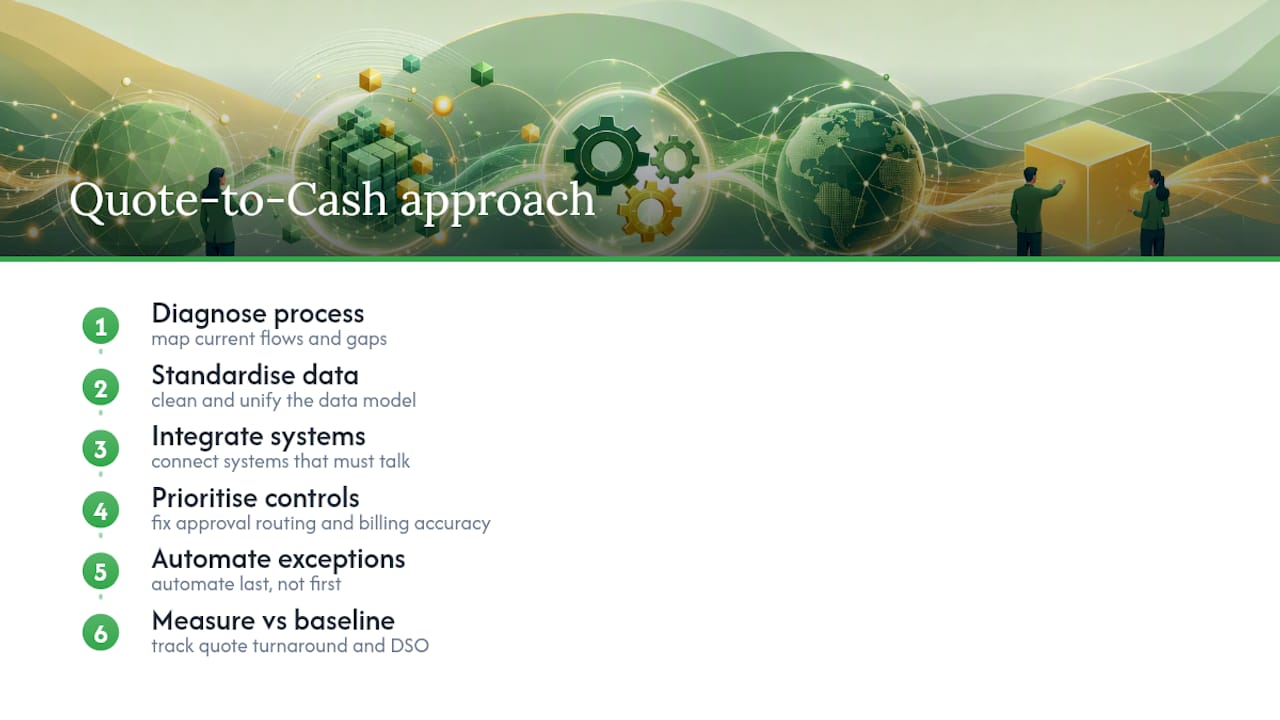
The methodology we follow is deliberately unglamorous: diagnose the current process, standardise the underlying data, integrate the systems that need to talk to each other, automate the exceptions last (not first), and measure everything against a baseline. Skipping straight to automation before the data model is clean is the single most common reason these projects underdeliver.
Client work in operations automation has shown the same pattern repeatedly: quote turnaround and DSO both improve fastest once approval routing and billing accuracy are fixed, before touching the harder revenue recognition layer.
— Admin
Get a quote-to-cash system built around how you actually sell
Off-the-shelf CPQ and billing tools assume your pricing, approvals and contracts already fit a standard mould. Most businesses find out halfway through implementation that theirs don't. Futuregrid builds the integration layer and the exception logic around your actual catalogue and approval structure, instead of asking you to bend your business to fit a generic workflow.
Our engagement model runs discovery, a scoped pilot, the build, and ongoing support, so you see quote turnaround and DSO improvements before committing to a full rollout. That structure typically means lower revenue leakage and faster invoicing within the first working quarters, not a vague promise a year out. If your quoting and billing still depend on someone manually checking a spreadsheet before anything gets invoiced, that's the gap worth closing first. Get in touch through our operations automation page to scope a pilot against your own numbers.
Where to go deeper on quote-to-cash
For further reading: Gartner's order-to-cash insights on integration strategy, and APQC's benchmarking library for setting realistic KPI targets.